
Why Is Electrical Data More Valuable Than a Single Reading?
The Finder DC Power Analyser turns changing electrical conditions into structured information that engineers can monitor over time. This compact instrument can become part of a wider Data Acquisition (DAQ) strategy for renewable-energy systems, battery installations, EV charging equipment and industrial DC networks. The result is a clearer view of how power enters, leaves and behaves within an installation.
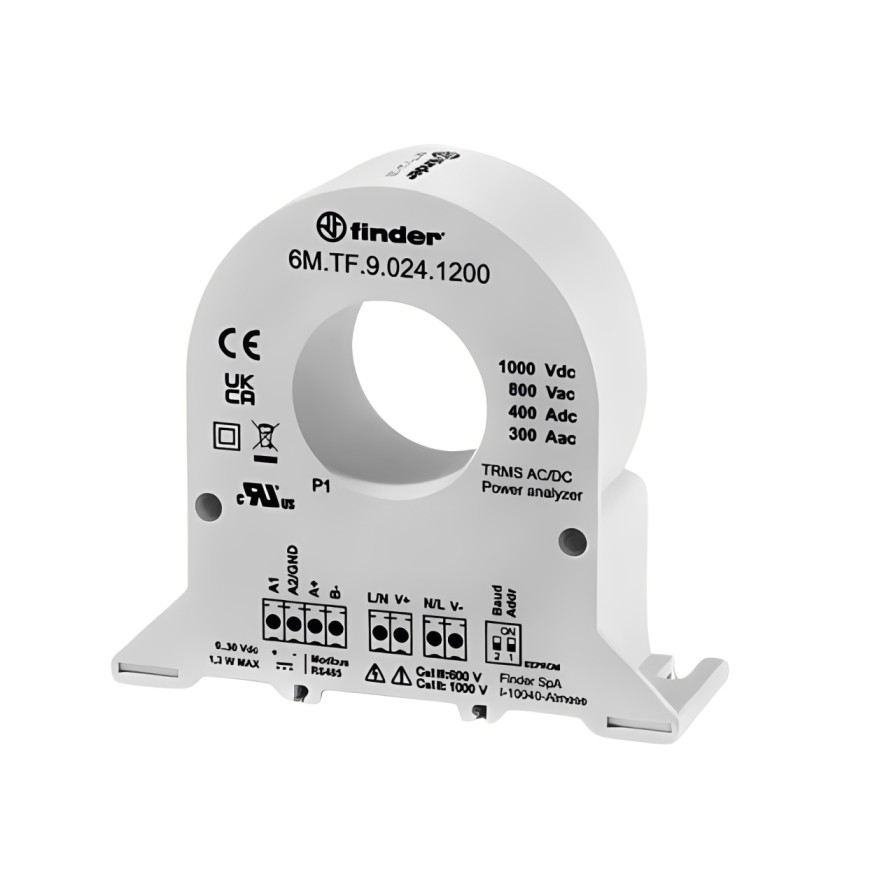
Manufacturer part number 6M.TF.9.024.1200 belongs to Finder’s 6M Series and supports true RMS measurement on AC and DC circuits. It can measure bidirectional energy, making it useful where a system alternates between consumption and generation. It supplies data that can support control decisions, maintenance planning and performance assessment.
What Does the Analyser Actually Measure?
The analyser evaluates voltage, current, power and accumulated energy. Its operating range extends to 300 A and 800 V AC, or 400 A and 1000 V DC, making it suitable for demanding systems when installed according to Finder’s technical instructions. Voltage and current accuracy is specified at class 0.5% of full scale.
True RMS processing matters when waveforms are not perfectly sinusoidal. Converters, chargers, inverters and switched loads can create distorted signals, and a basic average-reading method may not represent their effective value accurately. TRMS measurement therefore helps the monitoring system describe real operating conditions reliably.
Why Is Bidirectional Measurement Important?
Power does not always travel in one direction. A battery may charge during periods of surplus energy and discharge when demand rises. A photovoltaic installation can supply local equipment and later draw energy from another source. Regenerative machinery may also return energy during braking.
Bidirectional measurement enables the Finder DC Power Analyser to distinguish these changing flows. Engineers can calculate imported and exported energy, identify charging and discharging patterns, or compare generation with consumption. Correct conductor orientation and configuration are essential because an installation error may reverse the reported direction.
How Does a Screen-Free Analyser Deliver Useful Information?
This model is designed for connected monitoring rather than local visual display. It communicates through Modbus RS485, allowing a compatible controller, gateway or computer to request measurement values. The receiving system can display live status, record trends, generate alarms or combine electrical data with production information.
Multiple compatible devices can share an RS485 bus. Each unit needs a unique address, while baud rate, parity and other settings must match across the network. Where data must continue onto Ethernet infrastructure, suitable Industrial Hubs & Switches may form part of the wider architecture after an appropriate RS485 gateway.
How Does DIN-Rail Design Improve Panel Integration?
The analyser mounts on standard DIN Rails, helping designers position it alongside control and distribution equipment. Properly selected Terminal Blocks can keep measurement, supply and communication conductors clearly identified and accessible.
Space planning should include wiring bend radius, separation from noisy power conductors and room for maintenance. The module carries an IP20 rating, so it requires installation inside a suitable protective enclosure. Its stated operating-temperature range of −15°C to +65°C must be considered against the temperature inside that enclosure.
What Does the 24 V DC Supply Requirement Mean?
The analyser uses a nominal 24 V DC auxiliary supply and operates across a stated 9–30 V DC range. This supply powers the measuring electronics and communication functions; it is separate from the circuit being monitored. Designers should check polarity, conductor size and supply stability before energising the device.
The auxiliary circuit needs protection selected according to the manufacturer’s instructions and panel design. Appropriate Rail Mount Fuse Holders can support an orderly protection arrangement. The analyser measures electrical behaviour but does not replace fuses, circuit breakers or other protective devices.
Which Installation Details Protect Data Quality?
Reliable data begins with sound wiring. Measurement conductors should follow the specified connection diagram, while RS485 wiring should use the correct topology, screening practice and termination. Star branches, duplicated addresses or inconsistent communication settings can produce intermittent or missing values even when the analyser is working.
Panel entry points also matter. Correctly sized Cable Glands can provide strain relief and help maintain the enclosure’s intended ingress protection. Installers should route communication wiring away from high-interference circuits where practical and maintain the separation required by applicable standards.
How Should the System Be Commissioned?
Commissioning should begin with the supply isolated and the wiring checked by a competent person. The engineer should confirm terminal allocation, polarity, conductor direction, auxiliary voltage and protective arrangements before applying power. Communication parameters can then be entered and tested from the supervisory device.
A known operating condition provides a useful functional check. Technicians can compare the reported voltage and current with suitable reference measurements, confirm whether power direction is positive or negative as intended, and verify that accumulated energy changes correctly. Recording the Modbus address and configuration simplifies future maintenance.
Where Can This Power Analyser Add the Most Value?
The Finder DC Power Analyser is especially useful in solar PV installations, energy-storage systems, charging infrastructure, industrial DC distribution and automation panels. Continuous data can reveal unexpected standby demand, declining conversion efficiency, unusually long charging cycles or loads operating outside their expected profile.
Its greatest value appears when measurements lead to action. Trend data can guide maintenance, inform energy-saving changes and help teams investigate events with evidence rather than assumptions. When correctly specified, installed and integrated, MPN 6M.TF.9.024.1200 creates a dependable link between electrical power flow and the digital systems used to manage modern energy assets.