
Why Is a Festo MHE4 Pneumatic Solenoid Valve So Fast?
Introduction
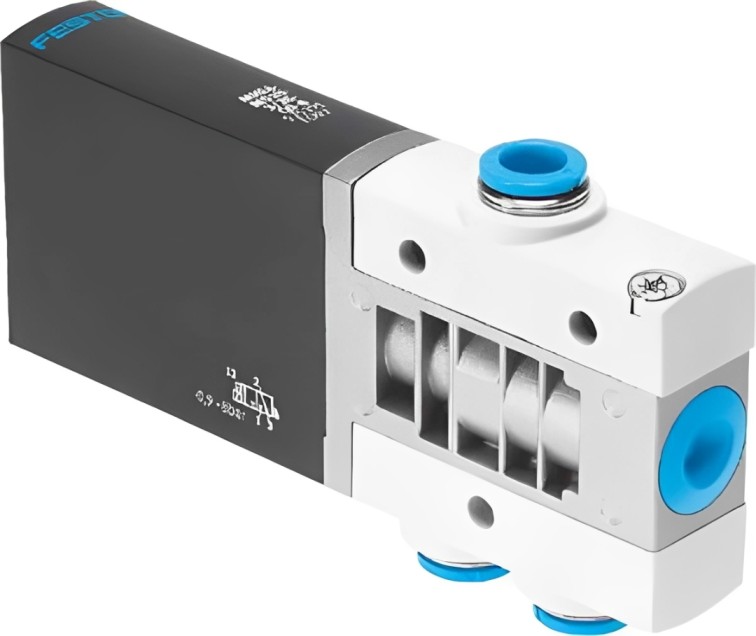
A Festo MHE4 Pneumatic Solenoid Valve provides rapid and repeatable compressed-air switching for machines that depend on precise timing. Its compact construction lets engineers position the valve close to the application, shorten pneumatic lines, and reduce delays between an electrical command and the resulting movement.
The MHE4 belongs to Festo’s MH4 fast-switching valve range. Individual versions differ in connection style, electronics, mounting arrangement, and operating details, so buyers should confirm the complete part number before specifying a replacement.
What Makes the MHE4 a Fast-Switching Valve?
General pneumatic valves suit many motion-control tasks, but high-speed dispensing, sorting, testing, and assembly often demand tighter switching consistency. The MHE4 uses a directly actuated poppet-valve design developed for short response times and strong repetition accuracy.
Festo lists MH4 3/2-way variants with a standard nominal flow rate of 400 litres per minute and 24 V DC operation. Individual, semi-in-line, and sub-base versions allow the installation to suit different machine layouts.
Why Short Pneumatic Lines Matter
Even a fast valve can produce slow machine response when it sits too far from the actuator or nozzle. Long tubing adds internal volume and flow resistance, so compressed air takes longer to reach the working point.
Mounting the MHE4 near the application reduces this delay. Suitable Pneumatic Quick Connect Couplings can also create practical service connections where equipment must be disconnected without disturbing the wider circuit.
How Does a 3/2-Way MHE4 Valve Operate?
A 3/2-way valve has three ports and two switching states. In a normally closed configuration, the supply port remains blocked when the coil is not energised, while the working port connects to exhaust.
Once the electrical signal is applied, the internal element changes position and connects the supply to the working port. Removing the command allows the valve to return to its normal state.
This principle supports blow-off nozzles, ejectors, single-acting actuators, dispensing equipment, and other processes requiring rapid on-and-off airflow.
How Does Electrical Integration Affect Performance?
The control system must provide the correct voltage, current, wiring, and switching method for the chosen MHE4 model. A mismatched supply can prevent reliable actuation or damage the electrical section.
Where compatible formats are used elsewhere in an installation, DIN 43650 Solenoid Connectors provide protected electrical interfaces for suitable valves and related devices. Installers must still verify the exact connector fitted to the selected MHE4.
Related Solenoid Valve Coils should only be chosen after checking voltage, power, connection pattern, duty cycle, and compatibility. A visually similar coil is not automatically an approved replacement.
Where Can the MHE4 Improve Process Accuracy?
Rapid and consistent switching can improve applications where small timing variations affect the finished result. Examples include adhesive dispensing, air-pulse cleaning, component sorting, leak testing, and fast product handling.
Typical uses include:
- Delivering short and controlled air pulses
- Operating compact single-acting devices
- Controlling vacuum generation in pick-and-place systems
- Sorting products on fast conveyors
- Supporting repeatable dosing and dispensing
- Activating testing or inspection functions
- Managing rapid exhaust or pressurisation cycles
In vacuum handling circuits, suitable Vacuum Switches can confirm whether the required negative pressure has been reached before the controller continues the sequence.
How Can Exhaust Design Improve Cycle Speed?
Air must leave a pneumatic chamber efficiently before the next movement can occur. Restricted exhaust lines, undersized silencers, or long return paths can reduce the advantage of a fast-switching valve.
Appropriate Pneumatic Quick Exhaust Valves allow air to discharge closer to an actuator when faster evacuation is required. The component must be sized correctly because excessive back pressure can still slow movement.
When Are Non-Return Valves Useful?
Some installations need to preserve pressure in one section or prevent reverse airflow after the MHE4 changes state. A check valve can support this function when the circuit is designed for controlled one-way flow.
Correctly selected Pneumatic Non-Return Valves may support pressure retention, vacuum protection, or branch isolation. Engineers must assess trapped pressure and safe exhaust behaviour before adding one.
Can Pneumatic Timing Components Complement the Valve?
The MHE4 usually responds to PLC commands. However, some circuits use pneumatic time-delay components for local sequencing or simple control functions.
Suitable Pneumatic Timers can introduce a controlled delay where their range, pressure, and operating logic match the application. Electronic control may remain preferable when timing changes frequently.
What Should Buyers Check Before Ordering?
The product name alone does not identify every operational detail. Buyers should compare the exact MHE4 code with the machine specification.
Important checks include:
- Valve function and normal switching position
- Operating voltage and electrical interface
- Standard nominal flow rate
- Switching-time requirements
- Pressure and temperature limits
- Individual, semi-in-line, or sub-base mounting
- Threaded or push-in pneumatic connections
- Manual override configuration
- Environmental protection requirements
- Suitability for compressed air or limited vacuum use
The surrounding tubing, connections, supply pressure, and exhaust arrangement must also support the intended cycle speed.
How Should the MHE4 Be Installed and Maintained?
Mount the valve close to the working device while keeping it accessible for inspection. Follow the marked port arrangement, prevent contamination from entering open connections, and avoid loading the body through unsupported tubing.
Before commissioning, confirm the wiring, pressure, airflow direction, and control signal. Pressurise the circuit gradually and test both the energised and rest states under safe conditions.
During maintenance, inspect cables, seals, connections, and exhaust paths. Isolate electrical power, shut off the compressed-air supply, and release stored pressure before removing the valve.
Why Choose the Correct Festo MHE4 Pneumatic Solenoid Valve?
The correct Festo MHE4 Pneumatic Solenoid Valve can shorten response times, improve process repeatability, and support compact machine construction. Its value is especially clear where milliseconds influence dispensing accuracy, handling speed, or production quality.
Reliable results depend on matching the exact configuration to the voltage, pressure, flow, mounting, connections, and control strategy. Installed close to the application and supported by a well-designed circuit, the MHE4 can deliver responsive operation across demanding automation cycles.