
Why Use an RS PRO Conductivity Meter for Water Testing?
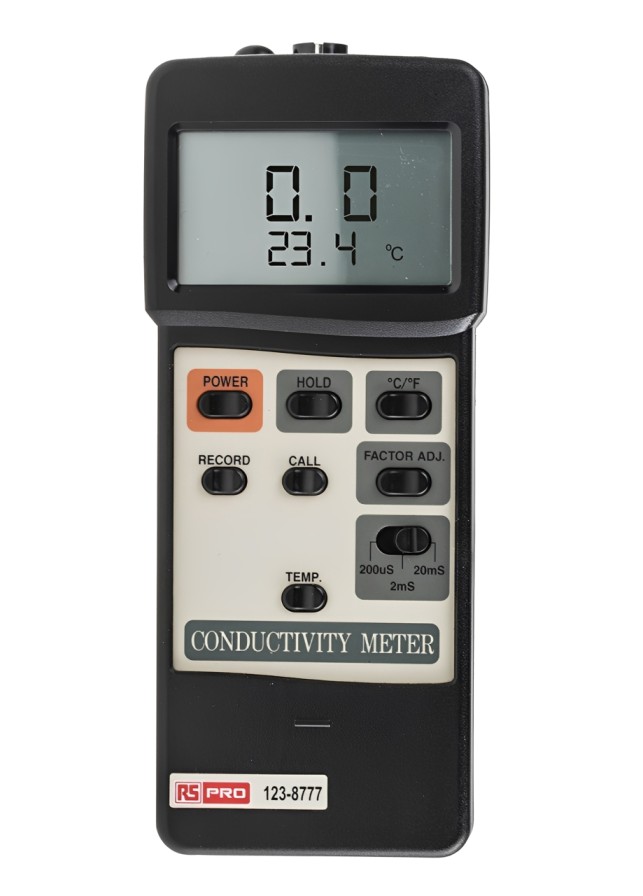
How Can Conductivity Measurements Improve Water Quality Control?
For routine liquid testing and process checks, an RS PRO Conductivity Meter provides a practical way to detect changes in the ionic content of water and other suitable solutions. Instead of identifying individual dissolved substances, conductivity testing measures how easily electrical current passes through the liquid.
This makes conductivity particularly useful for comparative monitoring. A sudden increase or decrease in a normally stable reading can indicate that the condition of the water or process has changed and requires further investigation.
RS PRO model 123-8777, for example, provides several measurement ranges, simultaneous conductivity and temperature display, automatic temperature compensation, data hold and minimum, maximum and average memory functions.
What Is the RS PRO 123-8777 Conductivity Meter Designed For?
RS PRO 123-8777 is a portable battery-powered instrument intended for conductivity and temperature measurements. RS specifies a minimum conductivity of 0.1 µS/cm, a maximum conductivity of 199.9 µS/cm on its listed primary specification, ±2% accuracy and 0.1 µS/cm or 0.01 mS/cm resolution depending on the selected range.
The instrument also provides 200 µS, 2 mS and 20 mS measurement ranges, allowing it to work across different conductivity levels. Its portable format makes it suitable for field checks, laboratory work and maintenance measurements.
Why Is Conductivity Useful for Comparing Water Samples?
Conductivity responds to electrically charged ions dissolved in a liquid. When ionic concentration changes, the conductivity value normally changes as well.
This makes the measurement particularly valuable when technicians need to compare samples from different stages of a process. For example, readings may be taken before and after water treatment, cleaning, filtration or another process to determine whether a meaningful change has occurred.
Where measurements need to be recorded over longer periods, Data Loggers can support structured collection and storage of process or environmental measurements. EnrgTech’s populated range includes portable and connected logging equipment for laboratory, industrial and environmental applications.
Why Does Water Temperature Change Conductivity Results?
Temperature influences the movement of ions within a solution. As temperature changes, the measured conductivity can change even when the chemical composition of the sample remains essentially the same.
RS PRO 123-8777 addresses this issue with adjustable automatic temperature compensation from 0 to 5% per °C. It can also display conductivity and temperature simultaneously, with temperature compensation specified across 0°C to 60°C.
Independent Digital Thermometers can also be useful when technicians need additional temperature measurements elsewhere in a process or laboratory setup. EnrgTech maintains a populated range covering laboratory and industrial temperature monitoring.
Can Conductivity Testing Detect Water Contamination?
Conductivity can indicate that the concentration of conductive dissolved material has changed, but it cannot identify the exact contaminant.
For example, if a process normally produces water within a stable conductivity range and the value suddenly rises, additional ions may have entered the system. This can alert technicians that further investigation is necessary.
However, conductivity alone cannot determine whether the change was caused by a particular salt, mineral, chemical or other ionic substance. Additional analytical testing may therefore be required when the exact composition matters.
Where Is an RS PRO Conductivity Meter Commonly Used?
RS identifies water conditioning, aquariums, food processing, photography, laboratory applications and quality control among applications for the 123-8777 conductivity meter.
Other potential conductivity-monitoring environments include:
- Water-treatment processes
- Laboratory sample comparison
- Rinse-water monitoring
- Cleaning systems
- Aquaculture
- Agricultural water checks
- Cooling-water monitoring
- Quality-control departments
- Maintenance troubleshooting
- Process development
For broader testing requirements, Environmental Testers cover instruments used to monitor parameters across environmental, laboratory and industrial applications. EnrgTech’s populated range includes equipment for parameters such as temperature, humidity, air quality and other environmental conditions.
How Can Conductivity Data Be Used for Process Trending?
A single measurement tells the user what the sample condition is at that moment. Repeated measurements can reveal whether conductivity remains stable or gradually changes over time.
Trend analysis can help identify:
- Gradual contamination
- Changes after filtration
- Cleaning-process effectiveness
- Variation between production batches
- Water-treatment performance
- Increasing dissolved-ion concentration
- Unusual process behaviour
For more sophisticated monitoring systems, Data Acquisition equipment can collect sensor signals and convert them into digital information for analysis, recording and process evaluation. EnrgTech lists populated data-acquisition solutions for research, manufacturing, testing and quality-control applications.
What Features Help With Routine Conductivity Testing?
Portable test instruments are most useful when operators can obtain readings quickly without complicated setup.
RS PRO 123-8777 includes several functions intended to support routine measurement:
- Multiple conductivity ranges
- Automatic temperature compensation
- Conductivity and temperature display
- Data hold
- Maximum reading memory
- Minimum reading memory
- Average reading memory
- Approximately 0.8-second sampling
- Automatic power-off
- RS-232 serial interface
- Large dual LCD display
- Portable battery operation
RS supplies this model with a conductivity electrode, carrying case and instruction manual, while the PP3 battery is specified separately.
Why Are Minimum, Maximum and Average Readings Useful?
A single measurement can occasionally be influenced by sample movement, probe position or a temporary process condition.
Minimum, maximum and average functions allow the operator to observe how readings behave during the measurement period rather than relying exclusively on one displayed value.
For quality-control work, this can help reveal whether the conductivity is relatively stable or fluctuating substantially during testing. RS PRO 123-8777 includes memory recall for minimum, maximum and average values.
Can an RS PRO Conductivity Meter Transfer Data to a Computer?
The 123-8777 model includes an RS-232 PC serial interface. This provides an option for integration with compatible computer-based recording or analysis arrangements.
For applications requiring longer-term graphical records, Chart Recorders can record changing process variables over time. EnrgTech’s current range includes electronic and paperless recorders used for laboratory, industrial and process monitoring.
The appropriate recording method depends on whether the user needs occasional manual readings, continuous trends or automated data storage.
How Do You Get Consistent Conductivity Measurements?
Consistency depends on both the instrument and the measurement technique.
Operators should use a repeatable sampling procedure and ensure that the conductivity electrode is clean before measurement. Cross-contamination between samples should be avoided, particularly when moving between liquids with substantially different conductivity levels.
Allow the measurement to stabilise and use temperature compensation appropriately. The probe should also be stored and maintained according to the manufacturer’s instructions.
RS offers a dedicated replacement carbon conductivity probe, stock number 439-1091, for use with conductivity meter 123-8777.
Why Does Calibration Matter in Conductivity Measurement?
Any measurement instrument used for quality control should be checked according to the accuracy requirements of the application.
Calibration and verification help establish whether an instrument continues to provide readings within acceptable limits. The required frequency depends on factors such as usage, measurement importance, laboratory procedures and quality-management requirements.
For facilities maintaining multiple types of measuring equipment, Multi Function Calibrators provide tools for checking various electrical and process measurement instruments. Their suitability for a particular conductivity system must still be determined from the instrument and calibration procedure.
Is a Portable Conductivity Meter Better Than an Inline Sensor?
The better choice depends on how often measurements are required.
A portable conductivity meter is useful when:
- Multiple locations need testing
- Samples are checked manually
- Troubleshooting is occasional
- Laboratory comparison is required
- Permanent installation is unnecessary
An inline conductivity system may be more suitable when continuous process monitoring and automatic control are required.
Portable instruments therefore offer flexibility, while permanently installed systems provide continuous information.
What Should You Check Before Buying an RS PRO Conductivity Meter?
Start with the expected conductivity range of the liquid because this determines whether the instrument can provide useful resolution across the values of interest.
Also check:
- Minimum conductivity
- Maximum conductivity
- Resolution
- Measurement accuracy
- Temperature compensation
- Operating temperature
- Probe compatibility
- Data-memory functions
- Computer-interface requirements
- Battery type
- Sampling speed
- Required portability
RS PRO currently offers different conductivity-meter models with different ranges and functions, so buyers should compare the exact stock number rather than assuming every RS PRO meter has identical specifications.
Why Choose the Right RS PRO Conductivity Meter?
A correctly selected RS PRO Conductivity Meter can provide quick and repeatable information about changes in the ionic condition of water and other suitable solutions.
For applications involving routine quality checks, laboratory comparison, water conditioning or process troubleshooting, features such as multiple ranges, temperature compensation, min/max/average memory and portable operation can make conductivity monitoring easier to manage.
The most useful results come from choosing the correct measurement range, maintaining the electrode properly, controlling sampling conditions and interpreting conductivity as one part of the wider liquid-quality assessment.